


FR - (updated 11/2025) Comte chocolate is above all a gourmet adventure with roots dating back to 2020. It is also a story of career change and life journeys, which we at UzEssentiel love to hear about. After more than 25 years in the wine industry, Éric Comte decided to devote himself to the craft of chocolate making, from bean to bar. His father, a fine cocoa farmer in Ecuador, and a few decisive encounters were behind his career change.
|
The Hacienda Eleonor covered 200 hectares, including 20 hectares of the highly sought-after Arriba Nacional variety of cocoa trees, planted on former pasture land by Pierre-Yves Comte in 2015 (Comte chocolatier).
|
This was followed by training at CIRAD in Montpellier on ‘Becoming a Cocoa Expert’, followed by a presentation by Chloé Doutre-Roussel, a chocolate expert we mentioned in a previous article on chocolate, ‘an international consultant living in Latin America who provides training on cocoa and chocolate with her partner Maria Fernanda Di Giacobbe’, a Venezuelan chef and chocolatier.
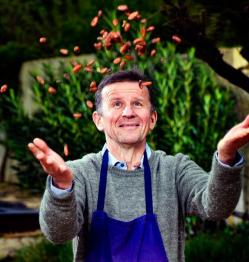 Comte chocolate bars, an adventure to savour... Tasting session
From wine to chocolate, we remain in the world of aromas... Why did you embark on this professional adventure?
Tasting is crucial, whether you work with wine or chocolate. You have to know how to taste and appreciate grapes and cocoa beans. In 2015, my parents started growing cocoa trees by creating a plantation in Ecuador, and my father suggested that I market the cocoa beans from their Eleonor plantation when the trees began to produce. I then began visiting chocolatiers and quickly realised that the market was very small, as 95% of chocolatiers do not process cocoa beans. They buy chocolate for coating.
After completing a few training courses, I created my own brand, COMTE with an ‘Aime’ (like in French), with the notable support of Chloé Doutre-Roussel, who trained me in cocoa selection and the process of transforming beans into chocolate bars. I continue to seek her advice on a regular basis.
|
Camboa cocoa beans from Brazil, organically produced in the Mata Atlantica region near Bahia (source), Ucayali from Peru, near the town of Pucallpa, where farmers now favour the planting of cocoa trees, coffee trees, etc., with the support of, among others, the Peruvian Cocoa Alliance (source), Quiñindé in the Amazon region of Ecuador, where, since 2010, plantation owners in this region known as the ‘golden nugget’ have been increasingly replacing oil palm cultivation with cocoa trees (source).
|
You mention Chloé Doutre-Roussel... How did her collaboration contribute to your project and how did it complement the work you had done at CIRAD?
Chloé Doutre-Roussel's expertise was not limited to the technical aspects of the cocoa bean processing stages (sorting on receipt of the beans, roasting, breaking and winnowing the beans to obtain cocoa nibs, then refining and conching under the pressure of granite millstones, and finally maturing, tempering and moulding). Chloé also taught me a great deal about marketing and tasting both beans and chocolates. Furthermore, joining the Bean to Bar France association brought me into contact with other cocoa and chocolate enthusiasts. The exchanges between members are very enriching and help us to progress.
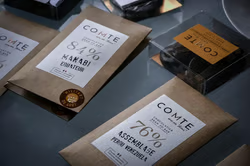 Can you tell us morre about your cocoa beans?
At first, I obviously worked with cocoa from Hacienda Eleonor, of the Fino de Aroma Arriba Nacional variety, a variety endemic to Ecuador, which has become rare because, in the 1980s, it was replaced by varieties that were lower in quality but higher in yield. Then came Chuao from Venezuela, another exceptional product. Its history is fascinating: Chuao has been cultivated for generations by the descendants of slaves who washed up on the coast. Settling in a remote village, they were the first to cultivate cocoa trees in South America. Today, the women of this community still manage the plantations, drawing on the secrets of this centuries-old culture. Madagascar cocoa is also a clever blend of Trinitario and Criollo (Sambirano dark chocolate 76% cocoa).
Over time, other plantations and cooperatives have naturally joined the movement: the Ucayali cooperative in Peru, which works exclusively with organic farming methods, and the Camboa plantation in Brazil, one of the oldest plantations to have obtained organic certification.
|
Chuao cocoa? Grown in a valley in the central mountain range of the Venezuelan coast, Chuao cocoa is a blend of Criollo and Forastero cocoa, whose fruits, with their pronounced aromas, owe their chemical, physical and organic qualities to the altitude, temperature and humidity specific to the Chuao climate (source).
|
 How long did it take you to find the right balance of ingredients for your bars? You talk about tempering, moulding, texture...
Chocolate processing is a work of patience and meticulousness. The right amount of sugar added at the right time to the cocoa paste to fix the right aromas, the right temperature for conching, not skimping on the refining and conching time either (3 days). You have to achieve the ideal texture while preserving the aromas of the cocoa.
It took me 3 months after training with Chloé to achieve a result that satisfied me and before I could offer it for sale. It was a period during which we ate a lot of chocolate as a family and I gave a lot to friends! What was your very first bar? My first bars were 76% and 84%, created with beans from Hacienda Eleonor.
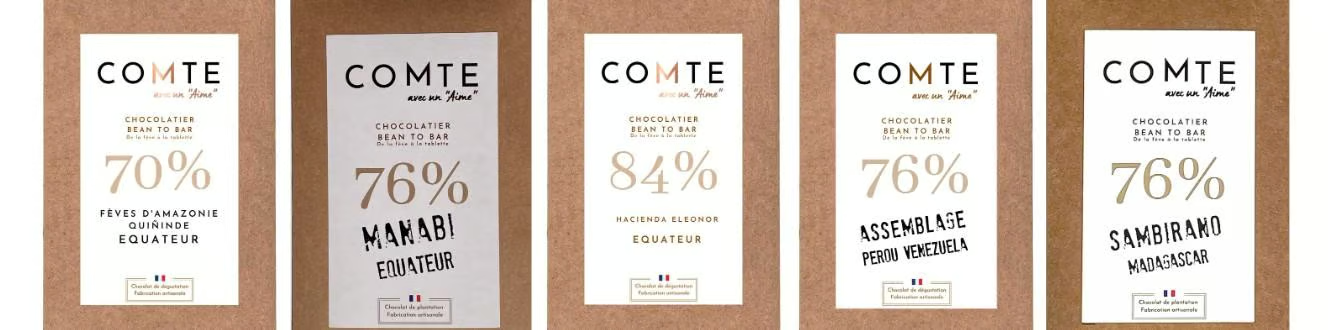
Since then, I have expanded my range of bars (which includes some delicious forays into milk chocolate, fruit (raspberry, lemon) and ginger) and introduced a few new products: Manabi bar (76% cocoa dark chocolate from Ecuador), Mendiants aux noisettes du sud-ouest (76% cocoa dark chocolate from Brazil), Candied orange slices (76% dark chocolate from Brazil), Gianduja with organic hazelnuts, Candied ginger strips and dark chocolate... and the latest addition, the ‘Dolce gusto’ mocaccino.
Oh yes, and let's not forget to mention the delicious Praliné with olive oil and Camargue fleur de sel. 36 hazelnuts, 36 almonds, 1 cocoa pod, 1 whole sugar cane stalk and 15 olives for a 150g jar). That's a lot of people around this little jar!
You're the only one at the helm of your micro chocolate factory. Who are your testers?
First and foremost, my wife, who is also my business partner. She has impeccable taste. During our blind tastings, I know right away if the chocolate gets her approval... or not. My customers also give me their opinions and ideas.
We find your chocolate at the restaurant Chez Alexandre, run by chef Michel Kayser in Garons, at chef Olivier Douet's Lou Mas Café in Nîmes, but where else?
Indeed, these chefs place their trust in me and I am very proud to supply them with my chocolate for their pastries. These collaborations have grown stronger over time, with each party contributing their expertise, ideas and desires, which allows us to evolve in our work, in the search for the best product or to adapt to specific requests. It's a real challenge.
You can also find my chocolate bars (cult, favourites, for hedonists) in many delicatessens, in the south of course such as, around Uzes, at Côté frais, Les compagnons du terroir & Moulin à huile du paradis, but also in Paris, Alsace, Brittany and on my website.
|
For a gourmet and surprising touch to a festive meal, I suggest you try grated chocolate on foie gras... Exquisite! (Eric Comte) |
Would you like to add any details or comments?
When I worked in the wine business, my wife often helped me with blind tasting samples and creating blends. But when I finally switched to chocolate, I found her much more motivated!
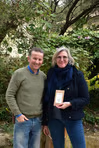
Many thanks to Eric Comte for his collaboration on this article and the images provided.
The right address: Comte chocolatier, Carré d'Art SARL, 5, Place de la Fontaine, Cabrières. Tel: 06 22 20 12 51.
Photos chocolate bars & mendiants©Sylvie Duplan.
Source: * Chloé Chocolat.